
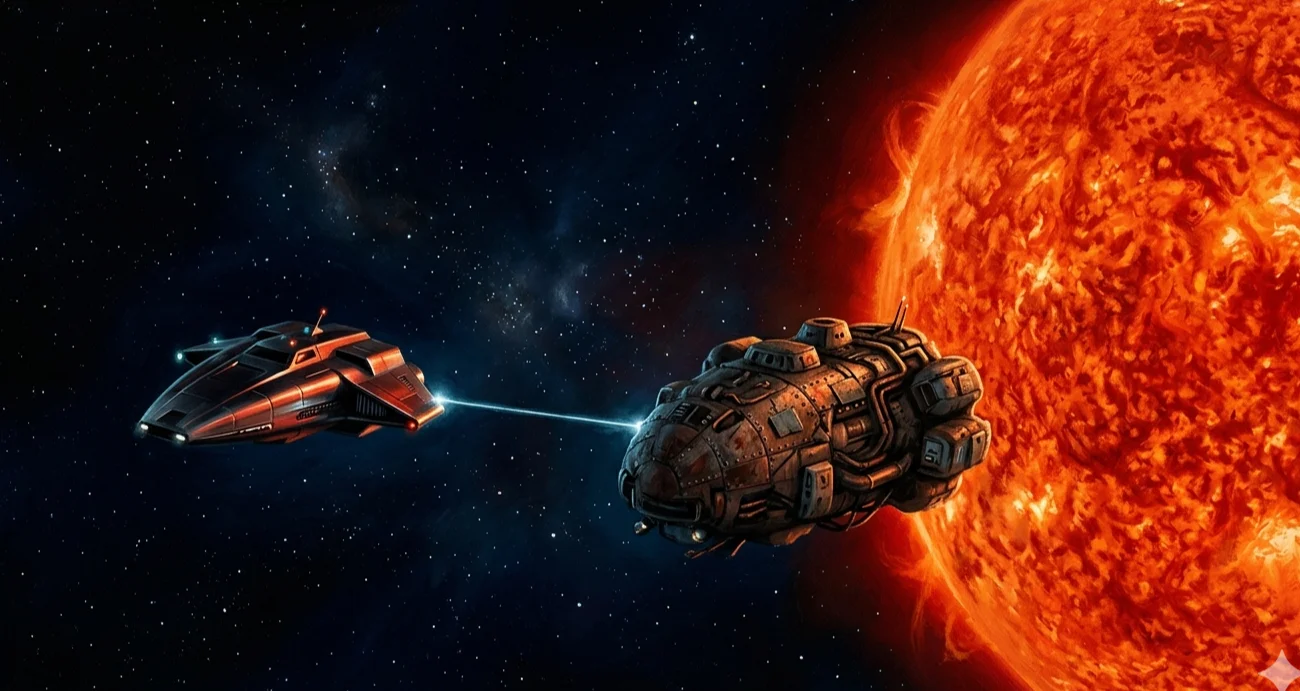
I watched the movie first. Loved it. Ryan Gosling was charming, the visuals were great, and I walked out of the theater thinking I’d gotten the full story.
Then I listened to the audiobook. Sixteen hours. And I realized the movie had given me the highlights reel of something much bigger.
What the book is (no spoilers)
Project Hail Mary is a science fiction novel by Andy Weir. A middle school science teacher wakes up alone on a spaceship. He doesn’t know why he’s there. He doesn’t remember how he got there. Two crew members are dead beside him. And Earth has a problem that he was apparently sent to solve.
That’s all the plot I am going to share in the spoiler free version.
What makes the book work is the way it handles science. Weir doesn’t skip over the problem-solving. When the protagonist needs to measure gravity, he doesn’t just “check the instruments.” He ties a thread to a weight, makes a pendulum, and uses the swing period to calculate gravitational acceleration.
Enjoying this?
Get the next essay in your inbox, most Sundays.
This pendulum scene is the book in miniature. A problem, a physics-based solution, the satisfaction of watching someone think through it properly. The whole novel runs on this engine.
The audiobook question
There’s a character in this book who doesn’t speak English. Or any human language. The audiobook renders their speech as actual musical tones. Chords. Notes. You hear what this character sounds like. I don’t know how the print version conveys this, but hearing it was something else entirely.
The audiobook also has one frustration. There’s a notation system in the book where characters are represented by Greek letters. Alpha, beta, delta, pi. In print, you’d see these as symbols and map them to their meanings. In audio, you’re hearing someone read out letter names in sequence, and I couldn’t track what corresponded to what. Probably not a problem on paper.
On balance, audio was the right format for this book.
Should you read it?
If you love science fiction, this should be in your top three or four books to pick up. I’d put it alongside Liu Cixin’s Three-Body Problem trilogy as science fiction that takes its science seriously without sacrificing story.
Do you need a physics background to enjoy it? Not really but you would enjoy it more if you do. The characters carry the story on their own, and the friendship at the center of the book is special regardless of what you know about orbital mechanics. But if you understand basic Newtonian physics and a bit about how relativity works, the book rewards you for it. You stop listening a character solve problems and start solving them alongside him. That’s a different experience. A better one, if you can access it.
If you watched the movie and thought you got the full experience, you didn’t (movie is great, by the way). The patient buildup, the tension, the explanation, the science given the space to work. All of that lives in the book.
Full spoilers from here. Come back after you’ve read the book.
The book says Ryland is a coward. I don’t buy it.
The book establishes early on that Ryland Grace wasn’t one of the original astronauts slated to go on the Hail Mary mission. Later, it was revealed that Dr. Stratt had to send him involuntarily. The framing is clear: he’s brilliant but not brave. A scientist, not a hero.
However, I never felt that while listening.
A coward would not have kept going after waking up alone on a spaceship with two dead crew members. A coward would not have continued a mission he couldn’t even remember. That’s not cowardice. That’s someone whose scientific curiosity is stronger than his fear.
When Ryland first encounters Rocky’s ship, he doesn’t hesitate. He grabs an artifact Rocky sends over. He goes on a spacewalk to retrieve something from Rocky’s vessel. He tries to open an alien object without knowing what’s inside. None of this is cowardly behavior.
On Earth, sure. He said no to going to space. That’s self-preservation. But once he was in space, I never saw a hint of the coward the book kept telling me he was. His scientific brain kept overriding whatever fear he might have felt.
So when the Stratt flashback scene arrived, the one where he refuses the mission, it felt anti-climactic. Not because it was badly written. Because by that point, I’d already spent hours with a version of Ryland who didn’t match the label.
Rocky
Rocky grew on me slowly. When he first appeared, he was interesting but not much more. An alien engineer. A plot device with a personality.
Then the relationship started building. The banter. The sarcasm. Rocky calling Ryland “stupid, stupid, stupid” when he couldn’t figure something out. The worry in his voice when things went wrong. The constant, anxious concern about his home planet Erid.
What made Rocky feel real, and not like a human in an alien costume, was the specificity. He’s an engineer, not a scientist. He builds things. Ryland thinks through problems theoretically. Rocky builds solutions. The mission would have failed without both of them, and the book never lets you forget that. Two people from different species, needing each other equally.
And then Rocky comes out of his pressurized environment to save Ryland’s life. An Eridian, in an atmosphere that could kill him, because his friend was in danger. That’s when Rocky stopped being a great character and became one of my favorite characters in anything I’ve read.
The scene
Ryland jumps out of his spaceship into open space to reach Rocky’s vessel. No guarantee he’ll make it. A few hundred feet of nothing between him and his friend.
This is the guy the book calls a coward.
When Rocky’s voice comes through from inside the ship, a couple of octaves higher than normal, his excitement unmistakable, and Ryland says “I am here, buddy.” Listening to this emotions, I welled up. Genuinely.
It works because the book earned it. Twelve hours of a friendship building across a language barrier, across species, across every possible difference. All of that compressed into one line.
The forest and the tennis balls
This is the moment that sold me on Weir as a writer of science, not just science fiction.
Ryland finally makes nitrogen-resistant Taumoeba. The mission is going to work. And then he discovers the Taumoeba have also become xenonite-resistant. They’re escaping through the walls of the container designed to hold them.
Ryland’s theory for how this happened is an analogy.
Imagine a forest. If you shoot tennis balls into the forest, the balls travel in straight lines and stop wherever they hit a tree. None of them reach the other side. But a human walking through the same forest can weave around the trees, take detours, find a path through. The Taumoeba had been sitting in that xenonite container long enough to evolve the biological version of that zigzag. They learned how to hide inside the atoms of xenonite itself.
I don’t know if this is defensible molecular biology. That’s not the point. The analogy works as an analogy, and watching a character reason through a problem using this kind of lateral thinking feels like watching a scientist actually think. That’s what the book keeps doing. Giving characters problems, then letting them work through the problems the way people would. Not the way a plot demands.
The part I didn’t buy
The global cooperation.
I can accept astrophage. I can accept close-to-light-speed travel. I can accept an alien species that communicates in musical chords. Science fiction asks you to accept premises, and I’m fine with that.
But every government on Earth setting aside politics to work together seamlessly? Covering the entire Sahara Desert with astrophage material in months? That’s where the book lost me.
Here’s the test. Humanity has decades of evidence that climate change is real. Scientists have been screaming about it since I was in school. Temperatures are literally measurable. And we still can’t agree on whether it’s happening, let alone agree on a coordinated response. If we can’t align on something that boring and slow, the idea that astrophage would cause every nation to hand its authority to one Dutch woman with a clipboard feels generous.
Weir knew this was a problem. That’s why he invented Stratt. Giving one person absolute authority is the mechanism that makes the rest of the story possible. The book needed humanity to move fast, so he wrote a character who could force humanity to move fast. But political leaders from powerful countries don’t just step aside when something important happens. They want their names on the letterhead. They want influence over the direction. The smoothness of the Hail Mary project, the absence of anyone trying to claim the spotlight, the speed of the Sahara rollout. None of that felt real.
I went along with it because the rest of the story was good enough to carry me past it. But it was the one premise I couldn’t quite swallow.
The ending, and what’s missing
I was satisfied with the ending. We learn that Earth was saved. Ryland gets closure, even if it means he can’t go home. There’s a completeness to it.
But I wanted one more chapter.
The entire book is told from Ryland’s perspective. That works. It’s the right choice for the story. But it means we never see what happens on Earth when Taumoeba arrives. We never see Stratt’s reaction.
Stratt is the most interesting character in the book besides Rocky. She has absolute power and she uses it without flinching. She sends Ryland to space without his consent and she knows she’ll answer for it. She says at one point that she’s going to hell. She has a hard exterior that the book never lets us see behind.
An epilogue from her perspective would have answered questions the main narrative can’t. What did she feel when Ryland’s solution arrived? Did she feel vindicated? Relieved? Did all the ruthless decisions feel worth it in the end? Twenty-six years passed on Earth while Ryland was gone. What happened to her and more importantly, Earth in that time?
The book doesn’t owe me this. But I would have loved to read it.